Master CELPIP Speaking Task 3: Describing a Scene with CLB 7 Clarity
In CELPIP Speaking Task 3: Describing a Scene, you are shown a detailed, busy illustration (such as a crowded airport, an outdoor market, or a library) and asked to describe what is happening in as much detail as possible. You have 30 seconds to prepare and 60 seconds to record your response.
The most common pitfall in Task 3 is "random list scanning." Candidates bounce around the image, pointing out random people without any organization or prepositions of place. This leads to a messy response that is difficult to follow. To score a **CLB 7 or higher**, you must use a **spatial organization template** to guide the listener's eyes smoothly across the picture.
Task 3 Golden Rule: Continuous Action
Always describe people's actions using the **Present Continuous tense** (verb + -ing). Instead of saying "A man drinks coffee," say "A man **is drinking** coffee." This sounds much more natural for active descriptions.
1. The Blueprint: Spatial Description Template
A CLB 7+ response should move systematically: from an overall summary to the background, foreground, left side, right side, and finally a specific center focal point.
"This illustration depicts a vibrant and busy [park/market/office] scene with several individuals engaged in various outdoor activities."
"Starting with the background, I can see [objects/buildings]. Towards the upper [left/right] corner, there is a..."
"Moving to the left foreground, a [person] is [action] while next to them, another person is [action]. Meanwhile, on the right side of the image, we can observe..."
"Right in the center of the scene, there is a [notable event/animal]. Overall, the atmosphere appears to be very lively and energetic."
2. Prepositions & Spatial Connectors
Using correct prepositions of place is critical for readability and coherence. Instead of repeating "next to" or "there is," use these sophisticated directional markers:
Never say "in the bottom" or "on the center." The correct structures are: **"at the bottom"**, **"in the center"**, and **"in the background/foreground"**.
| Spatial Zone | Prepositions & Phrases |
|---|---|
| Background | In the background, / In the upper-left corner, / In the distance, |
| Foreground | In the foreground, / At the bottom-right of the picture, |
| Proximity | Adjacent to, / Directly opposite, / Parallel to, / Alongside, |
3. Step-by-Step Sample Response
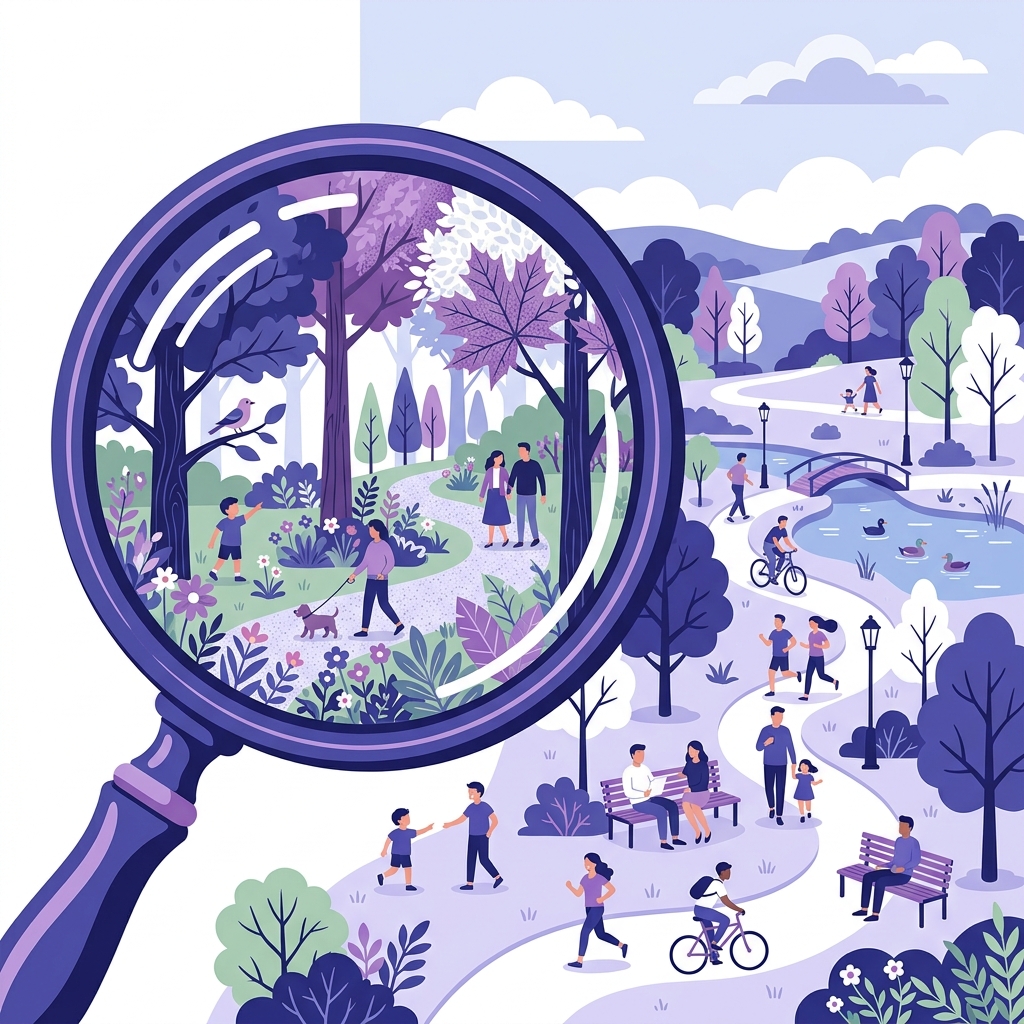
Let's apply our spatial organization template to a typical park scene illustration:
"This illustration depicts a vibrant and busy park scene with several individuals engaged in various outdoor activities.
Starting with the background, I can see a couple of tall maple trees and a modern building far in the distance. Towards the upper left corner, a bright yellow sun is shining behind a thin white cloud.
Moving to the left foreground, an elderly man is sitting on a wooden bench, reading a newspaper. Adjacent to him, a young woman is jogging along a paved pathway, wearing pink running shoes. Meanwhile, on the right side of the image, we can observe a family having a picnic, with a mother spreading a red checkered blanket while her child plays with a ball.
Right in the center of the scene, a small brown dog is chasing a blue frisbee. Overall, the atmosphere appears to be very lively and relaxing."
Build Your Success Framework
A spatial template makes it easy to structure your observation. Tweak our blueprint, load up your practice dashboard, record your response, and let our smart AI evaluate your spatial descriptions today.
Table of Contents
Ready to Ace Your CELPIP?
Practice Writing and Speaking under exam conditions with our realistic, timers-enabled mock interfaces. Get instant, thorough AI scoring and diagnostic advice!
Start Practice FreeRelated Articles